RECYCLING HARDY & WRIGHT

9 06 2012

AVERAGE ORDER OF DEDEKIND PSI FUNCTION


Dedekind psi function called my attention, when I was trying to find trivial properties and formulas related to Jordan’s totient functions, that are indeed just generalizations of Euler’s totient function. At that time I realize that values in range of psi had similarities to those of divisor sigma, because trivialy: \sigma_{1}(n) - \psi(n) \geq 0, (inequality that holds for squarefree numbers). So, It seems reasonable to look for an alternate inequality to Robin’s criterion but with Dedekind psi instead of divisor function.

Fortunately, this question was settled, before my discovery of gunpowder, by true mathematicians like Patrick Sole and Michel Planat ([3] and [4]).

Riemann Hypothesis (RH) is true if and only:

\psi(n) 30

After I found these papers on the internet, my interest on Dedekind psi function became huge, and then I begun to look for more and more information about this arithmetical function on my library. But the real thing is that psi is never given the importance on every Number Theory book that it deserves. This was good to me because it gave me the opportunity to populate The On-Line Encyclopedia of Integer Sequences with my trivialities related to this function. This the modest mission of this blog: to create math not in the books.

As I’m a copycat and Euler’s totient is first cousin of Dedekind psi, the idea is to turn \varphi formulas into \psi with a small retouch, for example if:

\frac{n}{\varphi(n)}=\sum_{d|n}{\frac{{\mu(d)}^2}{\varphi(d)}}

Then you can discover the unpublished:

\frac{n}{\psi(n)}=\sum_{d|n}{\frac{\mu(d)}{\psi(d)}}

The same thing can be done “recycling” the analytic theorems about the average order of number theoretical functions that came on the most cited book on the topic: Hardy and Wright’s An Introduction to the Theory of Numbers, particularly Theorem 330 on the average order of Euler’s Totient can be easily rewritten to get, the not so easy to find, average order of Dedekind psi, just implementing the following expressions along theorem development:

\psi(n)= n \cdot \prod_{p|n}{\left( 1 + \frac{1}{p} \right)}

\psi(n)= n \cdot \sum_{d|n}{ \frac{|\mu(d)|}{d} }

(Taken from [4])

\sum_{d=1}^{\infty}{\frac{|\mu(d)|}{d^{2}}} = \frac{15}{{\pi}^{2}}

(See [6])

Proof:
\Psi(n) = \sum_{m=1}^{n}{\psi(m)} = m \cdot \sum_{d|m}{ \frac{|\mu(d)|}{d}} = \sum_{d \cdot d^{\prime} \leq n}{d^{\prime} \cdot |\mu(d)|} = \sum_{d=1}^{n}{|\mu(d)| \cdot \sum_{d^{\prime}=1}^{\lfloor \frac{n}{d} \rfloor}{d^{\prime}} = \frac{1}{2} \sum_{d=1}^{n}{|\mu(d)| \bigg( \bigg\lfloor \frac{n}{d} \bigg\rfloor^{2} + \bigg\lfloor \frac{n}{d} \bigg\rfloor \bigg) =

\frac{1}{2} \sum_{d=1}^{n}{|\mu(d)| \bigg\{ \frac{n^{2}}{d^{2}} + O \bigg( \frac{n}{d} \bigg) \bigg\} } = \frac{n^2}{2} \sum_{d=1}^{n}{ \frac{|\mu(d)|}{d^2} + O \bigg( n \sum_{d=1}^{n}{ \frac{1}{d} \bigg) } = \frac{n^2}{2} \sum_{d=1}^{n}{ \frac{|\mu(d)|}{d^2} + O \bigg( n^{2} \sum_{n+1}^{\infty}{ \frac{1}{d^2} \bigg) + O(n \cdot \log{n}) =

\frac{15n^{2}}{2{\pi}^2} + O(n) + O(n \cdot \log{n}) = \frac{15n^{2}}{2{\pi}^2} + O(n \cdot \log{n})

\Psi(n) = \frac{15n^{2}}{2{\pi}^2} + O(n \cdot \log{n})

Then the average order of \psi(n) is \frac{2}{n} \cdot \frac{15n}{{\pi}^2} = \frac{15n}{\pi^2}


Archives:
[a]-JordanTotientFunction.m


References:
 [1]-Patrick Sole and Michel Planat, Extreme values of the Dedekind Psi function, to appear in Journal of Combinatorics and Number Theory, arXiv:1011.1825v2
[2]-Michel Planat, Riemann hypothesis from the Dedekind psi function, arXiv:1010.3239v2
[3]-G.H. Hardy, E.M. Wright, An Introduction to the Theory of Numbers, Oxford University Press, 1979, 5th Edition pp 268, Theorem 330.
[4]- N. J. A. Sloane, The On-Line Encyclopedia of Integer Sequences. A001615: Dedekind psi function: n * Product_{p|n, p prime} (1 + 1/p)
[5]- Jonathan Vos Post, Feb 15 2010, The On-Line Encyclopedia of Integer Sequences. A173290: Partial sums of A001615.
[6]- N. J. A. Sloane, May 09 2003, The On-Line Encyclopedia of Integer Sequences. A082020: Decimal expansion of 15/Pi^2.


ADDING HELP TO OEIS SEQUENCES

31 07 2010

As I´m working on, more than one, small projects of programming sequences from The On-Line Encyclopedia of Integer Sequences, and as I always try to document my code the best I can: I like to add comments and help information to it, but after many hours of “copy and paste”, and being aware that when you are trying to do something with a computer: if you feel that everything is repetitive and boring, then it is for sure, that you are using the wrong procedure, so then, I decided to create a very simple tools to make my life easier.

The PHP code of these two on-line applications is almost the same than the one of OEIS2BibTeX, but this time changed to provide the help code for PARI/GP or Mathematica OEIS sequences functions.

Both applications can be used in two different ways:

* Entering the Sequence Id number with a HTML form: in a POST METHOD, or
* With the Id Number supplied to the PHP code within the link, using ?sequence=valid_ID


1) PARI/GP

1.1) HTML POST Method:
http://oeis2bibtex.netai.net/helpPARI_GP/

1.2) PHP Parameter:
http://oeis2bibtex.netai.net/helpPARI_GP/OEIS-PARI_GP-Help.php?sequence=A000200
Here you can change A000200 for the desired Sequence Id Number:


2) WOLFRAM MATHEMATICA

2.1) HTML POST Method:
http://oeis2bibtex.netai.net/helpMathematica/

2.2) PHP Parameter:
http://oeis2bibtex.netai.net/helpMathematica/OEIS-Mathematica-Help.php?sequence=A000200

2.3) Mathematica Code using Import:

As Mathematica can access on-line data, these functions can do the job too inside any Mathematica Notebook or Package:

OEISSequenceDescription[seq_String]:=Module[{dataloaded = StringJoin[Import["http://oeis.org/classic/?q=id%3a" <> seq <> "&fmt=3","Data"]], first, last},
first = Flatten[StringPosition[dataloaded, "%N"], 1][[2]];
last = Select[StringPosition[dataloaded, "%"][[All, 1]], # > first&][[1]];
StringReplace[StringTake[dataloaded, {first + 10, last - 1}], "  " ~~ _ -> ""]]


OEISAddHelp[seq_String]:=ToExpression[StringJoin[seq, "::usage=\"",seq, ": ", OEISSequenceDescription[seq], "\""]]

Archives:
[a]-073110-Adding Help to OEIS Sequences.nb


References:

[1]-PARI/GP Development Headquarters – Programming in GP: other specific functions-addhelp
[2]-http://formatmysourcecode.blogspot.com/
[3]-Wolfram Mathematica Documentation Center: Import
[4]-E.Pérez Herrero-OEIS Utilities Page@ OEIS Wiki


TOTIENT CARNIVAL

11 07 2010

Euler´s totient function: \phi(n) is defined as the number of positive integers less than or equal to n, that are coprime to n, and using Iverson bracket, \phi can be written as: (See reference [1])

\phi(n) =\sum_{i=1}^{n}{[gcd(i,n)=1]}

MULTIPLICATIVE BUT NOT COMPLETELY MULTIPLICATIVE FUNCTIONS:

The above summatory can be expressed with the aid of non completely multiplicative arithmetical funcions, using the fact that, some functions hold for inequalities similar to this one:

f(n \cdot m)  f(n) \cdot f(m); if gcd(n,m)\neq 1

And that also hold for the properties that any multiplicative function has:

f(n)> 0

f(n \cdot m) = f(n) \cdot f(m); if gcd(n,m)= 1

Then:

\phi(n)=\sum_{i=1}^{n}{\bigg\lfloor \frac{ f(i \cdot n)}{ f(i)\cdot f(n)}\bigg\rfloor}

And applying this idea to arithmetical functions of common use, we can give, for the divisor sigma functions, the Piltz divisor functions and the squarefree kernel [4], respectively:

\phi(n)=\sum_{i=1}^{n}{\bigg\lfloor \frac{\sigma_{k}(i \cdot n)}{\sigma_{k}(i)\cdot \sigma_{k}(n)}\bigg\rfloor}

\phi(n)=\sum_{i=1}^{n}{\bigg\lfloor \frac{\tau_{k}(i \cdot n)}{\tau_{k}(i)\cdot \tau_{k}(n)}\bigg\rfloor}

\phi(n)=\sum_{i=1}^{n}{\bigg\lfloor \frac{rad(i \cdot n)}{rad(i)\cdot rad(n)}\bigg\rfloor}

Or we can construct an implicit formula for the Totient function:

\phi(n)=\sum_{i=1}^{n}{\bigg\lfloor \frac {\phi(i)\cdot \phi(n)}{\phi(i \cdot n)}\bigg\rfloor}

But now we must take care that now:

f(n \cdot m) > f(n) \cdot f(m); if gcd(n,m)\neq 1

so we must invert the fraction inside the floor function.

ADDITIVE BUT NOT COMPLETELY ADDITIVE FUNCTIONS:

The same thing can be done with additive but not completely additive functions:

\phi(n)=\sum_{i=1}^{n}{\bigg\lfloor \frac{\omega(i \cdot n)}{\omega(i) + \omega(n)}\bigg\rfloor} \; (n>1)

OTHER FORMULAS:

This way of constructing new formulas, seems to be trivial and useless, but this is only an excuse to show how works the characteristic or indicator functions, that are underneath the behaviour of the arithmetical functions, and thus the basic Set Theory inside Number Theory.

And of course we can extend this collection of formulas to other functions distinct than \phi, like for example \pi the Prime Counting Function:

\pi(n)=\sum_{i=2}^{n}{\bigg\lfloor \frac{i+1}{\sigma_{1}(i)}\bigg\rfloor} \; (n>1)

\pi(n)=\sum_{i=2}^{n}{\bigg\lfloor \frac{\phi(i)}{i-1}\bigg\rfloor} \; (n>1)

\pi(n)=\sum_{i=2}^{n}{\bigg\lfloor \frac{2}{\tau(i)}\bigg\rfloor}=\sum_{i=2}^{n}{\bigg\lfloor \frac{k}{\tau_{k}(i)}\bigg\rfloor} \; (n>1)


Archives:
[a]-071210-Totient Carnival.nb


References:

[1]-Peter Luschny – OEIS-Wiki: Sequences related to Euler’s totient function.
[2]- N. J. A. Sloane, The On-Line Encyclopedia of Integer Sequences.
A000720: pi(n), the number of primes <= n. Sometimes called PrimePi(n) to distinguish it from the number 3.14159…
[3]- N. J. A. Sloane, The On-Line Encyclopedia of Integer Sequences.
A000010: Euler totient function phi(n): count numbers <= n and prime to n.
[4]- R. Muller, The On-Line Encyclopedia of Integer Sequences.
A007947: Largest squarefree number dividing n (the squarefree kernel of n)


A SMALL FIBONACCI SUM

13 05 2010

If F_{n} is the nth Fibonacci Number then:

\displaystyle \sum_{i=0}^{n}{i \cdot F_{2i}} = n \cdot F_{2n+1} - F_{2n}

This identity can be easily proved using the method of induction with the basic recurrence relation of Fibonacci Numbers.

How can we find methods for constructing new identities like this one?


References:

[1]-Wikipedia – Fibonacci number
[2]-Chandra, Pravin and Weisstein, Eric W. “Fibonacci Number.” From MathWorld–A Wolfram Web Resource – http://mathworld.wolfram.com/FibonacciNumber.html


BibTeX AUTOMATIC OEIS CITATIONS

14 02 2010

I’ve been programming a small web application in PHP to get automatically the BibTeX citation of any sequence in the The On-Line Encyclopedia of Integer Sequences.

If you follow this link: OEIS2BibTeX or just click on the above image, then you must enter the desired sequence ID to get the BibTeX citation data, that you can easily copy to your .bib file.

As I begun to learn PHP yesterday´s evening, and this is my first PHP programming, you can guess that this code must have more than one bug.

The citation is done using the @MISC BibTeX entry, that uses as Required fields: none, and as Optional fields: AUTHOR, TITLE, HOWPUBLISHED, MONTH, YEAR, NOTE.

The AUTHOR field contains the OEIS Sequence Author.

HOWPUBLISHED contains the url to the sequence in the OEIS Wiki, and it is assumed to be used with the \LaTeX hyperref packages

MONTH and YEAR are not yet used, and the field NOTE includes the Description of the sequence.

If this small application is used in combination with the BibTeX2HTML it is very fast to reuse the same bibliography data in your web, or in your \LaTeX document.

All the PHP archives can be downloaded and changed if desired.

The reference [1] is an example of how does the Plain format works.


References and Archives:
[1] Clark Kimberling. The On-Line Encyclopedia of Integer Sequences. A045051. Numbers n with property that in base 4 representation the numbers of 0’s and 2’s are 2 and 4, respectively.
[2] Andrew Roberts. Bibtex entry and field types.
www.andy-roberts.net/misc/latex/sessions/bibtex/bibentries.pdf.
[3] Psychedelic Geometry.PHP file. OEIS2BibTeX.php.
[4] Psychedelic Geometry.PHP file. default.php, feb 2010.
[5] Psychedelic Geometry. OEIS2BibTeX web site. http://www.oeis2bibtex.netai.net/, feb 2010.


READER’S CORNER (I)

17 01 2010


A BINOMIAL PLAY:

Our contributor Raymond Rogers has sent an alternate proof for:

\displaystyle det{\bigg[  \binom{i+j+k}{i} \bigg]}_{0\leq i,j \leq n} =\binom{n+k+1}{k+1}

This expression is identical to the one found in the post Binomial Matrix (III), but here the matrices are indexed from zero instead of one.

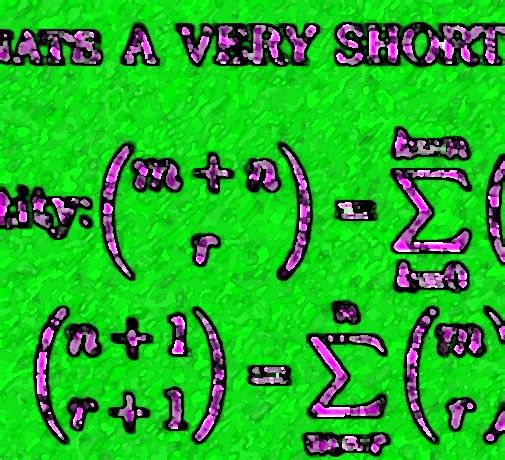
The proof is entitled A BINOMIAL DETERMINATE,A VERY SHORT PLAY IN THREE ACTS, and it is based on Vandermonde’s identity.

Thank you Raymond.


Archives:
[a]-120510-Binomial-Play-R.Rogers.pdf


Links:
[1]-Raymond Rogers, Lamm´s Equation, Confluent Hypergeometric Equations- Lamm´s Equation Blogspot


BINARY BISECTION

9 01 2010


INTRO:

The Bisection Method is a very well known root-finding algorithm that always comes at the very beginning of every book on Numerical Analysis.

The algorithmn searches for a root in the interval, [a_{0},b_{0}] in whose endpoints the continous problem function, f(x), takes opposite signs:

f(a_{0})f(b_{0})<0

The Bisection Method is based on Bolzano´s Intermediate Value Theorem, and it can give, also, an alternative proof for it. (Reference [1])

Here, it does not matter the function values: The algorithm does not use any other information from f(x), other than its sign changes.

There are excelent pages on the internet that treat this topic, (references [1], [2] and [3] for example), and it would be useless to add more redundant and, for sure, worse presented summary about this numerical method.

I just want to take out something hidden inside the computer software, a small piece of math inside the programming area.

THE LOST FUNCTION

The core of the Bisection Method is the conditional IF… THEN… sentence, where the algorithm chooses in which half of the interval is the desired root.

This conditional evaluation can be converted into a decision function, Let´s say \delta_i, that gives 0 if the root is on the left half interval and 1, otherwise.

Now the iterative sequence can be written using this function, \delta_i, where:

m_{i} is the midpoint of the search interval:

\displaystyle m_{i}=\frac{a_{i}+b_{i}}{2}

\delta_{i} is the decision function, and the \delta(i,j), in the second member, is the Kronecker´s delta:

\delta_i=\delta(sgn(f(m_{i})),sgn(f(a_{i})))

Then:

\delta_{i} = \left\{ \begin{array}{ll} 1 & \mbox{if } (sgn(f(m_{i})=sgn(f(a_{i})) \\\\ 0 & \mbox{if } (sgn(f(m_{i})\neq sgn(f(a_{i})) \end{array}\right\}

The endpoints of the search interval must be:

{[a_{i+1}, b_{i+1}]} = \left\{ \begin{array}{ll} {[m_{i},b_{i}]} & \mbox{if }(\delta_{i}=0) \\\\ {[a_{i},m_{i}]} & \mbox{if } (\delta_{i}=1) \end{array}\right\}

Then, they can be expressed with the aid of \delta_{i}, as:

a_{i+1}=a_{i}+\delta_{i}\cdot (m_{i}-a_{i})

b_{i+1}=b_{i}+(1-\delta_{i})\cdot (m_{i}-b_{i})

Note:
If f(x), has only a single root in the interval [a_{0},b_{0}], then it is possible to use an alternate version of the decision function:

\delta_i=\delta(sgn(f(m_{i})),sgn(f(a_{0})))

with the advantage that then it is not necessary to evaluate f(a_{i}) in the main loop of the algorithm: this implies an improvement in performance.

LENGTHS RATIO:

We can name the ratio of lengths between the intervals [a_{0},a_{i}], and [a_{0},b_{0}], as the parameter:

\displaystyle \theta_{i}=\frac{a_{i}-a_{0}}{b_{0}-a_{0}}

If \theta_{i} is expressed in function of \delta_{i}:

\displaystyle\theta_{i}=\sum_{k=0}^{i-1} \frac{\delta_{k}}{2^{k+1}}

The sequence formed by the distinct values of the decision function, \delta_{i}, matches up with the binary expansion (or the binary digits) of \theta_{i}

Then the midpoint and the endpoints of the interval in function of \theta_{i}, are:

a_{i}=a_{0}+(b_{0}-a_{0})\cdot \theta_{i}

\displaystyle m_{i}=a_{0}+(b_{0}-a_{0})\cdot \left(\theta_{i}+\frac{1}{2^{i+1}}\right)

\displaystyle b_{i}=a_{0}+(b_{0}-a_{0})\cdot \left(\theta_{i}+\frac{1}{2^{i}}\right)

HACKING BISECTION METHOD:

The connection between \delta_{i} and \theta_{i} can be used to convert the Bisection Method into a method for finding the binary expansion for a root of any function that holds the conditions that this method demands.

For example if we take:

f(x)=x^2-x_{0}, where x_{0}>0

with a_{0}=0 and b_{0}=2^{k}, where 2^{k-1} < \sqrt{x_{0}} < 2^{k}, then:

\displaystyle \sqrt{x_{0}}=\lim_{i \to +\infty}{\theta_{i}}

and the sequence of \delta_{i} gives the binary digits of \sqrt{x_{0}}


Archives:
[a]-010910-Binary Bisection.nb


References:

[1]-Mohamed A. Khamsi, Helmut Knaust – SOSMATH – The Bisection Method
[2]-John H. Mathews – California State Univ. Fullerton – Module for The Bisection Method
[3]-Holistic Numerical Methods Institute- – Bisection Method: Nonlinear Equations


TETRAHEDRAL NUMBERS RECIPROCALS SUM

25 12 2009

TETRAHEDRAL NUMBERS SERIES:

This post follows with the exercises on special numbers reciprocals related series, after the blog entries about Square Pyramidal Numbers and Polygonal Numbers . In fact, this example it is not very much interesting, but I wanted to write it before to deal with more difficult problems.

\displaystyle T_{n}=\frac{n(n+1)(n+2)}{6}=\binom{n+2}{3}

\displaystyle S(n)=\sum_{k=1}^{n}{\frac{1}{T_{k}}}=\sum_{k=1}^{n}{\frac{6}{k(k+1)(k+2)}}

If we split the main fraction into others:

\displaystyle \frac{S(n)}{6}=\sum_{k=1}^{n}{\frac{1}{k(k+1)(k+2)}}=\sum_{k=1}^{n}{\left( \frac{A}{k}+\frac{B}{k+1}+\frac{C}{k+2} \right) }

Solving the linear system of equations it gives:

\displaystyle A=\frac{1}{2} \; ; B=-1 \; ; C=\frac{1}{2};

This three series can be summed easily with the aid of the Harmonic Numbers:

\displaystyle \sum_{k=1}^{n}{\frac{1}{k}}=1+\frac{1}{2}+\frac{1}{3}+ \cdots +\frac{1}{n}=H_n

\displaystyle \sum_{k=1}^{n}{\frac{1}{k+1}}=\frac{1}{2}+\frac{1}{3}+ \cdots +\frac{1}{n}+\frac{1}{n+1}=H_n-1+\frac{1}{n+1}

\displaystyle \sum_{k=1}^{n}{\frac{1}{k+2}}=\frac{1}{3}+\frac{1}{4}+ \cdots +\frac{1}{n}+\frac{1}{n+1}+\frac{1}{n+2}=H_n-1-\frac{1}{2} + \frac{1}{n+1}+\frac{1}{n+2}

If we sustitute everything in the expression for the reciprocals sum:

\displaystyle \frac{S(n)}{6}=\frac{n}{n+1}-\frac{1}{2}-\frac{1}{4} +\frac{1}{2(n+1)}+\frac{1}{2(n+2)}

In the previous step we can see what does exactly means to be a “telescoping series“, the term H_n, has vanished and there is no need to handle the Euler Mascheroni Gamma and the Digamma Function:

H_{n}=\gamma + \psi_{0}(n+1)

Then the formula for the n-th partial sum is:

\displaystyle S(n)=\frac{3n(3+n)}{2(1+n)(2+n)}

And taking the limit we get:

\displaystyle S(\infty)=\lim_{n \leftarrow \infty}{S(n)}=\frac{3}{2}


References:[1]-Tetrahedral Number at- Wikipedia
[2]-Weisstein, Eric W. “Tetrahedral Number.” From MathWorld–A Wolfram Web Resource. http://mathworld.wolfram.com/TetrahedralNumber.html
[3] A000292-Tetrahedral (or pyramidal) numbers: C(n+2,3) = n(n+1)(n+2)/6. The On-Line Encyclopedia of Integer Sequences!


SPLITTING FTA FUNCTIONS (III)

23 12 2009

PILTZ DIVISOR FUNCTIONS (2)


THEOREM-2:

\displaystyle\tau_{j+k}(n)=\sum_{d|n}^{}{\tau_{j}(d)\cdot\tau_{k}\left(\frac{n}{d}\right)}

Proof:

The Piltz Divisor functions are multiplicative, so it is only necessary to prove the case p^{\alpha}

In the previous post we saw how:

\displaystyle\tau_{k}(p^\alpha)=\binom{\alpha+k-1}{k-1}

And if we apply p^\alpha to second member of the problem identity, then:

\displaystyle f(p^\alpha)=\sum_{d|p^\alpha}{\tau_{j}(d)\cdot\tau_{k}\left(\frac{p^\alpha}{d}\right)}=\sum_{i=0}^{\alpha}{\tau_{j}(p^i)\cdot\tau_{k}(p^{\alpha-i})}

\displaystyle=\sum_{i=0}^{\alpha}{\binom{i+j-1}{j-1}\binom{\alpha-i+k-1}{k-1}}=\binom{\alpha+j+k-1}{j+k-1}=\tau_{j+k}(p^\alpha)

This proof seems easy except for the binomial identity step:

\displaystyle\sum_{i=0}^{\alpha}{\binom{i+j-1}{j-1}\binom{\alpha-i+k-1}{k-1}}=\binom{\alpha+j+k-1}{j+k-1}

After several unfruitful tries to prove it, due to my lack of mathematical skills, I resigned myself to look for information about this problem on the bibliography, this formula look very close to the one found on reference [1] or [2], but with an additional variable, and after many reviews, I was glad to find a combinatorial version of the proof into the book of Chuan Chong Chen and Khee-Meng Koh [3]

This proof solved the problem, but it let me very much unsatisfied, and I begun to rethink about this topic again.

This problem is about Number Theory and not Combinatorics, and I had to revise the first lesson about the properties of Dirichlet Product:

Dirichlet´s functional convolution is associative, so we can put the brackets wherever we want, so:

\tau_{j+k}(n)=(\underbrace{I_{0}(n)*...*I_{0}(n)}_{j}) *( \underbrace{I_{0}(n)*...*I_{0}(n)}_{k})=\tau_{j}(n)*\tau_{k}(n)

This simple line proves this trivial property of the Piltz functions that I pedanticly considered as a Theorem, and it proves, as a tip, the binomial formula. The readers of this blog (if any) may forgive me.

But after all of this mess, I´ve learned many interesting things:

1) Number Theory counts with powerful mathematical tools than can be used for many unexpected purposes, just to mention the relationship between the Piltz functions and the Jacobi polynomials.
2) The properties of arithmetical functions can be used to get elegant proofs for binomial identities. (This is the opposite way that the one I took).
3) In my effort to deal with binomial identities, I discovered some formulas for determinants of matrices with binomial coefficients. (Well, there´s many articles about this topic, but I worked without previous knowledge of them). Anyhow, I haven´t found this formula somewhere but here.


References:[1]-Matthew Hubbard and Tom Roby – Pascal’s Triangle From Top To Bottom -Catalog #: 31000005
[2]-Ronald L. Graham, Donald E. Knuth, and Oren Patashnik (Reading, Massachusetts: Addison-Wesley, 1994 – Concrete Mathematics – Identity (5.26)
[3]-Chuan Chong Chen,Khee-Meng Koh – Principles and techniques in combinatorics page 88-Example 2.6.2-Shortest Routes in Rectangular Grid.


SPLITTING FTA FUNCTIONS (II)

21 12 2009

PILTZ DIVISOR FUNCTIONS (1)

INTRO:

If we look for an example of “Functions that depend only on coefficients”, our first idea should be the divisor function, \tau_{2}(n) because it is multiplicative with:

\tau_{2}(p^\alpha)=1+\alpha

Here, they only appear the coefficients but not the primes.

With the help of recursive Dirichlet Convolution of the unit, I_{0}(n)=1, it is possible to construct a sequence of arithmetical functions only dependent on the coefficients of the prime factors of any number, known as Piltz Divisor Functions, \tau_{k}(n), because they give the number of distinct solutions of the equation x_{1}x_{2} \cdots x_{k}=n, where x_{1},x_{2},\cdots,x_{k} run indepently through the set of positive integers) or, if preferred, they give the number of ordered factorizations of n as a product of k terms. (References [3],[4] and [11])

DEFINITION:

\displaystyle \tau_{1}(n)=I_{0}(n)=1

\tau_{k}(n)=\sum_{d|n}^{}{\tau_{k-1}(d)\cdot I_{0}(n/d)}=\sum_{d|n}^{}{\tau_{k-1}(d)}

This recursion can also be notated in terms of Dirichlet Product as:

(f*g)(n)=\sum_{d|n}{f(d)\cdot g(n/d)}

\tau_{k}(n)=\tau_{k-1}*I_{0}(n)


NOTES ON NOTATION:

The divisor function can be found on the literature as: d(n), \sigma_{0}(n), \tau(n), and in this post as \tau_{2}(n).
The “\sigma´s”, and “\tau´s” are two different series of arithmetical functions that share one element in common: The divisor function. With the help of this two notations, it is possible to remark what kind of series we are working with.

On the other hand the “d“, it is a simple notation that can be used for another purposes, were the belonging to this series of functions, does not matters.

Unfortunately, this happens not only with the divisor function, the mathematical notation on arithmetical functions related to Dirichlet convolution (or product) varies from one book to another, and not only distinct functions are named the same, but all cases of “non-biyectivity” between notations and functions can be found.

Hereinafter we are going to use:

I_{k}(n)=n^{k} ( like in Reference [3] but with I_{0}(n)=1 and I_{1}(n)=n)

The identity element for Dirichlet´s product (or unit function), using Kronecker´s delta notation, is:

\displaystyle \delta_{1n}= \bigg\lfloor \frac{1}{n} \bigg\rfloor (Reference [2])

\omega(n) means the number of distinct prime factors of n


PROPERTY:

\tau_{k}(n) is multiplicative because \tau_{k-1}(n), and \tau_{1}(n) are multiplicative.

This property can also be derived from the behavior of the Dirichlet Product, but we must note that although \tau_{1}(n)=I_{0}(n)=1 is a completely multiplicative function, its convolution: \tau_{2}(n) is multiplicative, but it is not completely multiplicative.

THEOREM: [1] and [4]

\displaystyle \tau_{k}(n)=\prod_{i=1}^{\omega(n)}{\prod_{j=1}^{k-1}\frac{\alpha_{i}+j}{j}}=\prod_{i=1}^{\omega(n)}{\binom{\alpha_{i}+k-1}{k-1}}; \; (k \ge 1)

Proof:

\displaystyle \tau_{k}(p^\alpha)=\sum_{d|p^\alpha}^{}{\tau_{k-1}(d)}=\tau_{k-1}(1)+\tau_{k-1}(p)+\tau_{k-1}(p^2)+ \cdots +\tau_{k-1}(p^\alpha)

\displaystyle \tau_{k}(p^\alpha)= \sum_{i=0}^{\alpha}{\tau_{k-1}(p^i)} =\sum_{i=0}^{\alpha}{\binom{i+k-2}{k-2}}=\binom{\alpha+k-1}{k-1}

Lemma:

\displaystyle \sum_{i=0}^{\alpha}{\binom{i+k-2}{k-2}}=\binom{\alpha+k-1}{k-1}

Proof:

From Parallel Summation Identity (References [6] and [8]):

\displaystyle \sum_{k=0}^{n}{\binom{k+r}{k}}=\binom{n+r+1}{n}

Substituing: \displaystyle n\rightarrow{\alpha} and \displaystyle k\rightarrow{i}

\displaystyle \sum_{i=0}^{\alpha}{\binom{i+r}{i}}=\binom{\alpha+r+1}{\alpha}

\displaystyle r\rightarrow{k-2} and with Pascal´s Symmetry Rule [7]:

\displaystyle \sum_{i=0}^{\alpha}{\binom{i+k-2}{i}}= \sum_{i=0}^{\alpha}{\binom{i+k-2}{k-2}}= \binom{\alpha+k-1}{\alpha}=\binom{\alpha+k-1}{k-1}


Corollary-1: Values of \tau_{k}(s), being s a squarefree number.

If s is squarefree then all coefficients of its factorization are \displaystyle \alpha_{i}(s)=1, then:

\displaystyle \tau_{k}(s)= \prod_{i=1}^{\omega(s)}{\binom{k}{k-1}}=k^{\omega(s)}

For a prime p, \displaystyle \omega(p)=1, and \displaystyle \tau_{k}(p)=k, and if s=1, then \displaystyle \omega(1)=0 and \tau_{k}(1)=1


Corollary-2:

\displaystyle \tau_{k+1}(n^k)=\tau_{k}(n^k)\cdot \tau_2(n)

Proof:

\displaystyle \tau_{k+1}(n)=\tau_{k}(n)\cdot \prod_{i=1}^{\omega(n)}{\frac{\alpha_{i}+k}{k}}

\displaystyle \tau_{k+1}(n^k)=\tau_{k}(n^k)\cdot \prod_{i=1}^{\omega(n^k)}{\frac{\alpha_{i}+k}{k}}

Like \displaystyle \omega(n^k)=\omega(n), and \displaystyle \alpha_{i}(n^k)=k\cdot\alpha_{i}(n):

\displaystyle \tau_{k+1}(n^k)=\tau_{k}(n^k)\cdot \prod_{i=1}^{\omega(n)}{\frac{k \cdot \alpha_i+k}{k}}=\tau_{k}(n^k)\cdot \prod_{i=1}^{\omega(n)}{(\alpha_i+1)}=\tau_{k}(n^k)\cdot \tau_2(n)


References:[1]-p.167-Exercise 5.b – Leveque, William J. (1996) [1977]. Fundamentals of Number Theory. New York: Dover Publications. ISBN 9780486689067
[2]-T. M. Apostol, Introduction to Analytic Number Theory, Springer-Verlag, 1976, pages 29 and 38
[3]-J. Sándor: On the Arithmetical Functions d_{k}(n) and d_{k}^{*}(n), Portugaliæ Mathematica 53, No. 1 (1996)
[4]-I.Vinogradov, Fundamentos de la Teoría de los Números, Editorial RUBIÑOS, ISBN 84-2222-210-8, Segunda Edición,chapter II, Exercise 11, page 44
[5]-J. Sándor, B. Crstici, Handbook of Number Theory (Vol II), Kluwer Academic Publishers, Springer, 2004 ISBN 1402025467, 9781402025464
[6]-Ken.J.Ward, Ken Ward’s Mathematics Pages, Parellel Summation-Formula 2.2.2
[7]-Matthew Hubbard and Tom Roby – Pascal’s Triangle From Top To Bottom -Catalog #: 1000001
[8]-Matthew Hubbard and Tom Roby – Pascal’s Triangle From Top To Bottom – Catalog #: 1100002
[9]-A000012-The simplest sequence of positive numbers: the all 1’s sequence. The On-Line Encyclopedia of Integer Sequences!
[10]-A000005-d(n) (also called tau(n) or sigma_0(n)), the number of divisors of n. The On-Line Encyclopedia of Integer Sequences!
[11]-A007425-d_3(n), or tau_3(n), the number of ordered factorizations of n as n = rst. The On-Line Encyclopedia of Integer Sequences!


Create your own website, free on WordPress.com.Create your own website.
Start free